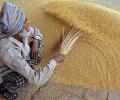
A head of its meeting, the Reserve Bank of India (RBI) can take some solace from the softening food commodity prices. However, the events surrounding the last few weeks show that the fall may not be uniform across all commodities, and cereals like wheat and rice could be the outliers. A Reuters report said that local wheat prices jumped to a record Rs 23,547 per tonne on Wednesday. That is a 12 per cent rise from the recent lows that followed the government's surprise ban on exports on May 14.

Making a strong case for bringing down the $600 per tonne export benchmark price for Indian onions which has made them uncompetitive, Agriculture Minister Sharad Pawar on Wednesday said the Minimum Export Price is double the prevailing rate in international markets.
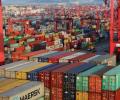
India's exports declined by 6.86 per cent to $34.48 billion in August this year as against $37.02 billion in the same month last year, government data showed on Friday. Imports too declined by 5.23 per cent to $58.64 billion as against $61.88 billion recorded in August 2022.

India's pharmaceutical exports to Iran have been hit owing to depleting rupee reserves in the West Asian country because of India stopping the import of crude oil from it in 2019 following US sanctions. Pharmaceutical exports dropped 71.25 per cent in April-August this year over the same period last year. The data from the Pharmaceutical Exports Promotion Council (Pharmexcil) showed exports to Iran had declined 31.29 per cent in 2022-23 as against the previous financial year.

The importance of China as India's top trading partner cannot be understated.

'Obviously, MSP hike raises chances of a reduction in exports. Even without an MSP hike, India's exports of a number of agri-commodities, like sugar, were unviable in the overseas markets.'

The escalation of conflict in the West Asian region is expected to push already high logistics costs besides hurting trade in sectors such as oil, electronics and agriculture, according to exporters. They said that insurance costs for exports to the countries directly involved in the war could also go up, which will impact Indian exporters' working capital. Think tank Global Trade Research Initiative (GTRI) stated that the conflict is already hurting India's trade with countries like Israel, Jordan, and Lebanon.

On the occasion of Chinese president Xi Jinping's two-day visit, Indian exporters are looking for a big boost in export of agricultural commodities, especially the ones that have been impacted by the ongoing trade war between the United States and China.
The decline in exports is mainly on account of poor demand in India's key destinations -- the Europe and the US -- and it may take some more months for the situation to improve. The demand scenario is "not looking very good as far as Europe is concerned, and the US also we have seen a decline in demand. "For the next 2-3 months, I think the demand scenario does not look very optimistic," DGFT (Director General of Foreign Trade) Santosh Kumar Sarangi told reporters.

The country's exports rose by about 6 per cent to a "record" $447 billion during 2022-23 on account of healthy growth in the outbound shipments of sectors such as petroleum, pharma and chemicals and marine, Commerce and Industry Minister Piyush Goyal said on Thursday. The country's imports also grew by 16.5 per cent to $714 billion in 2022-23 as against $613 billion in 2021-22. He said that the exports of goods and services together scaled "new heights" and has increased by 14 per cent to $770 billion in 2022-23 as against 676 billion in 2021-22.
Contracting for the third month in a row, India's exports declined by 8.8 per cent to $33.88 billion in February due to slowdown in global demand, even as the trade deficit touched about a year low of $17.43 billion during the month, according to official data released on Wednesday. Imports also declined by 8.21 per cent to $51.31 billion as against $55.9 billion recorded in the corresponding month last year. Cumulatively, however during April-February this fiscal, the country's overall merchandise exports rose by 7.5 per cent to $405.94 billion.

The surge in wheat export from India owing to the Ukraine crisis has once again demonstrated how farmers in states that have flexible marketing frameworks and low taxes benefit more from an emerging situation. The bulk of the wheat exported from India, trade and industry sources say, is being sourced at rates significantly higher than the state-mandated price of Rs 2,015 per quintal in Madhya Pradesh (MP), Uttar Pradesh (UP), and Gujarat - states which have low mandi taxes compared to Punjab and Haryana. This is not only benefiting farmers there but could also lead to significant savings for the states in procurement costs in the months to come.

India's gain will be an additional business of $300 million to $400 million per month if 10-11% of Bangladesh's export is diverted to Indian hubs like Tiruppur.

India's exports recorded a flat growth of 0.59 per cent to $31.99 billion in November, even as trade deficit widened to $23.89 billion during the month, according to the data released by the government on Thursday. Exports stood at $31.8 billion in November last year. Imports rose by 5.37 per cent to $55.88 billion in November as compared to $53.03 billion in the corresponding month a year ago, the data showed. During April-November 2022, exports rose by 11 per cent to $295.26 billion as against $265.77 billion in the same month last year.
India's exports entered negative territory after a gap of about two years, declining sharply by 16.65 per cent to $29.78 billion in October, mainly due to global demand slowdown, even as trade deficit widened to $26.91 billion, according to data released by the commerce ministry on Tuesday. Key export sectors, including gems and jewellery, engineering, petroleum products, ready-made garments of all textiles, chemicals, pharma, marine products, and leather, recorded negative growth during October. Imports during the month under review rose by about 6 per cent to $56.69 billion on account of increase in the inbound shipments of crude oil and certain raw materials such as cotton, fertiliser and machinery.
India's exports in January dipped by 6.58 per cent to $32.91 billion, as against $35.23 billion in the same month last year, according to the data released by the commerce ministry on Wednesday. Trade deficit in January stood at $17.75 billion.
Indian growth in the rest of this fiscal year and next will be propelled by robust domestic consumption as consumer confidence improves, and by investment, including large increases in government capital expenditure, according to the Asian Development Outlook September 2023. "As slowing exports could foment headwinds for the economy, and erratic rainfall patterns are likely to undermine agricultural output, the growth forecast for FY2023 is revised down marginally to 6.3 per cent," ADB said.

With hilsa prices soaring, when you do cook it you need the finest recipe.

India has put curbs on wheat exports through the government route, starting November last year. This comes amid a surge in domestic prices of the cereal. In December, India exported 391 tonnes of wheat to Bangladesh and Bhutan. In November 2022, it had exported 375 tonnes of wheat only to Bhutan.
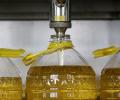
The protesting farmers' main demand to legalise the minimum support price (MSP) regime has divided opinion. One school of thought says it would lead to crop diversification and help India keep under check its burgeoning import bill on edible oils and pulses, while another says it would incentivise farmers to produce low-quality crops. Contrary to popular perception, India has a trade surplus in agriculture and allied activities, which stood at $18.65 billion during 2022-23 (FY23) against $15.92 billion in the previous year. However, the surplus was mainly on account of rice, wheat, sugar, spices, and buffalo meat.
The old farming practices will have to be changed to save the basmati export business.

He also said that his country would continue to talk about the Kashmir issue "through channels that are acceptable" and prayed that "the issue is amicably resolved".

India gets its first basmati billionaire family. The promoter family of KRBL reaps gains from high demand for basmati in India and overseas. The company had a stock of 300,000 tonnes of rice as of September 30.

Maldivian Foreign Minister Moosa Zameer on Saturday said India's gesture to renew the quota to allow the export of certain quantities of essential commodities for his nation signifies the longstanding bilateral friendship and the commitment to further expand trade and commerce.
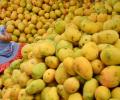
India has secured approval of the United States Department of Agriculture (USDA) for the export of domestic mangoes to America in the new season, the commerce ministry said on Tuesday. The export of Indian mangoes has been restricted by the US since 2020 as the USDA inspectors were unable to visit India for inspection of irradiation facilities due to restrictions imposed on international travel because of the COVID-19 pandemic. On November 23, 2021, the Department of Agriculture and Farmers Welfare and the USDA signed a framework agreement for implementing the "2 Vs 2" agri-market access issues.

Ahead of the seven-phase Lok Sabha elections, keeping food prices under check has emerged as one of the topmost priorities for the government. Food prices would likely have a bearing on the preferences of voters. In the past, there have been instances when governments have been voted out over rising food inflation.

One Chinese lie has been finally nailed this time by a team of Indian scientists who provide irrefutable evidence that rice did originate in India, a fact contested by China.
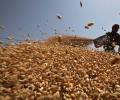
'We cannot afford to be complacent about our food security needs.'

'While criticising India's high tariffs, Mr Trump stated he would impose reciprocal taxes on Indian products if re-elected.' 'However, since India's tariffs follow WTO rules, Mr Trump's actions would violate these rules,' Ajay Srivastava points out.

The rains after arriving over Kerala will quickly cover Tamil Nadu and Karnataka, but then might slacken a bit, which could delay its arrival over Northwest India.
Exports in June rose by 23.52 per cent to $40.13 billion while the trade deficit ballooned to a record level of $26.18 billion mainly due to jump in gold and crude oil imports, the government data said on Thursday. The country's export growth in May was 20.55 per cent. Imports expanded by 57.55 per cent to $66.31 billion in June compared to the year-ago month, the data showed.
India's exports rose marginally by 1.62 per cent to $33.92 billion, while trade deficit more than doubled to $27.98 billion in August due to increased crude oil imports, commerce ministry data said on Wednesday. The revised data showed that imports rose by 37.28 per cent to $61.9 billion in August this year. The preliminary data released by the ministry on September 3 had shown a 1.15 per cent decline in exports to $33 billion in August.

Six decades and more later, we are now captives of our identities. Every poll is based on elaborate calculations of electability of candidates on the basis of their castes and other narrow definers. That, along with voter promiscuity, is what defines our political culture, which remains stubbornly resistant to any change, asserts Shreekant Sambrani.

The cost of a representative home-cooked vegetarian thali has witnessed a 5 per cent on-year increase in January, while that of the non-veg thali declined 13 per cent, a report said on Wednesday. According to Crisil Market Intelligence and Analytics (MI&A) Research 'Rice Roti Rate' estimates, the rise in prices of ingredients like pulses, rice, onion and tomato made home-cooked veg thali costlier in January, while decline in poultry rates helped in the fall in non-veg thali rates.
The Netherlands has emerged as India's fifth-largest export destination in 2021-22 (FY22), jumping from its 10th position a year ago. Exports to the fifth-largest economy in the European Union (EU) bolted 94 per cent to $12.5 billion in the financial year ended March 31. In FY22, the Netherlands surpassed Hong Kong, Singapore, the UK, Germany, and Nepal to become India's largest export destination in the EU. Germany, which was earlier India's top European export destination (eighth position), has now dropped two ranks to 10th place.
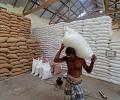
Amid the ongoing festival season and ahead of the elections for five state assemblies, the Centre is closely monitoring inflation, particularly in food items, to enable it to take steps to increase their supplies. "There is a complete no-nonsense attitude when it comes to food inflation, and instructions have been issued at all levels to be very sensitive to any possible price movements in any commodity," a senior official explained. Sources have said that all departments dealing with food items have been instructed to keep a close eye on all commodities and maintain a weekly record of their price movements.
The country's exports grew by 47.19 per cent to $35.17 billion on account of healthy growth in the outbound shipments of petroleum, engineering, and gems and jewellery, according to the provisional data of the commerce ministry. Imports during the month also rose by 59.38 per cent to $46.40 billion, leaving a trade deficit of $11.23 billion. Exports of petroleum, engineering, and gems and jewellery in July increased to $3.82 billion, $2.82 billion and $1.95 billion respectively, the data showed.
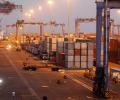
After recording positive growth for two months in a row, India's exports dipped marginally by 0.25 per cent to $27.67 billion in February and trade deficit widened to $12.88 billion, according to preliminary data released by the government on Tuesday. Imports grew 6.98 per cent to $40.55 billion during the month, the data showed. The trade deficit stood at $10.16 billion in February 2020. Exports during April-February 2020-21 were $255.92 billion, compared with $291.87 billion during the same period of last year, exhibiting a negative growth of 12.32 per cent.
Indian exporters are awaiting a formal announcement next week.
 © 2026 Rediff.com - Advertise with us - Disclaimer - Privacy Policy - Sitemap - Feedback - About us - Terms of use - Grievances